Most roofing problems start small and worsen gradually, which makes it easy to keep patching a roof well past the point where full replacement would actually serve you better. The key distinction is whether an issue is isolated or widespread: a single problem in one spot is usually a repair, while the same type of issue appearing in multiple locations across the roof often signals the underlying system has reached the end of its effective service life. Here's what to look for, adapted specifically for metal roofing.
Age Relative to Expected Lifespan
Age alone doesn't tell the whole story, but it's a practical starting point — a roof approaching or past its material's typical service life deserves closer scrutiny even if nothing looks obviously wrong yet.
• Standard GI galvanized steel commonly lasts 25-40 years, Galvalume 40-60 years, and aluminum or premium coated systems 50-70+ years — knowing which material and coating your existing roof uses tells you roughly where it stands in its expected lifecycle
• A roof nearing the upper end of its material's expected range warrants a professional inspection even without visible symptoms, since some issues (corrosion at fastener points, coating degradation) develop internally before becoming visible from the ground
• If you don't know your roof's installation date or material specification, checking permit records with the county or your original purchase documentation can establish this baseline
Visible Coating and Corrosion Issues
On metal roofing, coating condition is the visual equivalent of granule loss on asphalt shingles — the protective layer wearing down before the underlying structural failure becomes visible.
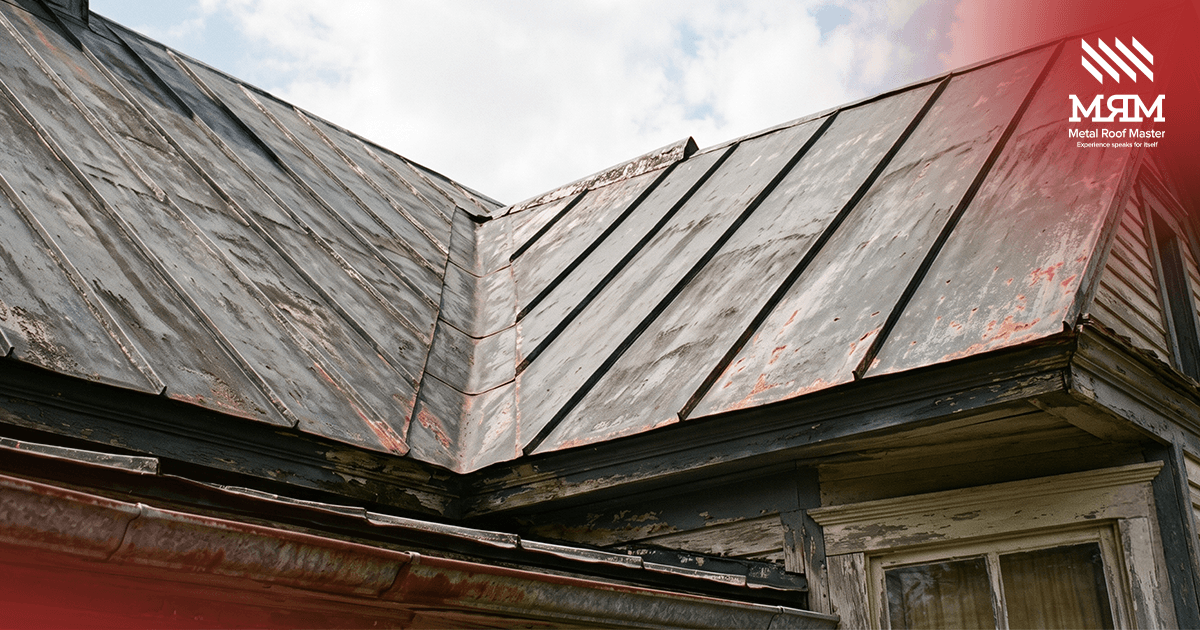
• Widespread chalking, fading, or coating breakdown across multiple roof sections indicates the protective finish has reached the end of its service life, not just isolated weathering
• Visible rust spots, especially if appearing in multiple locations rather than a single scratched area, suggest the underlying coating has been compromised more broadly than a simple touch-up can address
• Corrosion concentrated at fastener points or cut edges is a particularly telling sign, since these are the areas coating protection depends on most and where failure often starts
Panel and Seam Condition
Physical panel and seam issues that appear in isolation are usually straightforward repairs; the same issues appearing repeatedly across the roof point toward a broader problem.
• A single loose or lifted panel, particularly after a storm, is typically repairable — but multiple loose panels or seam separations across different areas suggest a systemic fastening or clip issue rather than an isolated incident
• Visible oil canning that has worsened significantly over time (rather than being a static cosmetic issue since installation) can indicate ongoing thermal movement problems that may eventually affect seam integrity
• Denting or impact damage concentrated in one area from a specific incident (falling branch, hail) is typically a repair; denting distributed across the whole roof may indicate the panel gauge was undersized for the property's actual conditions
Interior and Structural Warning Signs
Some of the most serious signs don't show up on the roof surface at all — they appear inside the structure, and by the time they're visible, the underlying issue has often been developing for a while.
• Water stains on ceilings or in the attic, especially if recurring in multiple locations or after multiple separate rain events, indicate an active leak that needs prompt professional attention
• Any sagging in the roofline or ceiling is a serious structural warning sign requiring immediate professional assessment, often indicating water damage or rot has compromised the roof deck or structural framing beneath the panels
• Daylight visible through the roof deck from inside the attic, or damp/discolored insulation, both point to active water intrusion that's been occurring for some time
• Unusually high cooling costs compared to similar homes can indicate compromised insulation or ventilation tied to roof deterioration, even without other visible symptoms yet
Repeated or Escalating Repairs
A pattern of recurring repairs, rather than any single dramatic sign, is often the clearest practical indicator that replacement makes more financial sense than continuing to patch an aging system.
• If repairs from just a few years ago are already failing again, or if you're calling a contractor for roof issues more than once every couple of years, the underlying system has likely moved past the point where repairs offer good value
• Calculate the cumulative cost of repeated repairs against a full replacement — repair costs that add up over a few years can approach or exceed replacement cost while leaving you with an aging roof rather than a fresh, fully warrantied one
• A licensed roofing contractor can provide a repair-versus-replacement assessment specific to your roof's condition, which is more reliable than trying to make this determination purely from visible symptoms alone
Insurance and Timing Considerations
As a roof approaches or exceeds its expected lifespan, insurance factors increasingly enter the replacement decision alongside the physical condition of the roof itself, particularly in Florida's tightening insurance market.
• Insurers increasingly scrutinize roof age during underwriting and renewal, and an aging roof can trigger higher premiums or non-renewal notices even if it's currently performing without major issues
• Replacing proactively, before insurance issues force the decision, generally allows more time for material sourcing, contractor scheduling, and financing planning than replacing reactively after a policy problem or storm damage
• If your roof is approaching the age where insurance scrutiny typically increases, getting an inspection and repair-versus-replacement assessment before that becomes an issue is worth the modest upfront time investment
When Repair Genuinely Makes More Sense
Not every issue points toward replacement, and it's worth being clear-eyed about when a repair is the appropriate, cost-effective response rather than defaulting to replacement out of caution.
• A single isolated incident — one storm-damaged panel, one failed sealant joint, one dislodged piece of flashing — is typically a straightforward, economical repair regardless of the roof's overall age
• A roof well within its expected service life showing only minor, isolated wear generally doesn't warrant replacement just because some maintenance issue has come up
• The goal is matching the response to the actual scope of the problem — treating every issue as a potential replacement trigger wastes money just as surely as ignoring genuine replacement-level deterioration does
Frequently Asked Questions
How do I know if my metal roof needs repair or full replacement?
Isolated issues — a single loose panel, one leak, localized denting — are typically repairable. The same types of issues appearing repeatedly across multiple areas of the roof usually indicate the underlying system has reached the end of its service life and full replacement is the more practical choice.
What's the biggest warning sign that a roof needs replacement?
Any sagging in the roofline or ceiling is one of the most serious signs, typically indicating structural damage from water intrusion or rot — this warrants immediate professional assessment rather than waiting for further symptoms.
Does a metal roof show age the same way as asphalt shingles?
Not exactly — metal roofing doesn't lose granules the way shingles do, but shows analogous wear through coating chalking and fading, corrosion at fastener points and cut edges, and (in more advanced cases) rust spreading across the panel surface.
Can an aging roof affect my homeowners insurance?
Yes — Florida insurers increasingly factor roof age into underwriting and renewal decisions, and a roof approaching the end of its expected service life can trigger higher premiums or non-renewal notices even if it's currently performing without major visible issues.
Is it ever better to repair than replace, even on an older roof?
Yes, if the issue is isolated and minor — a single storm-damaged panel or one failed sealant joint on an otherwise sound roof is typically a reasonable repair, regardless of the roof's overall age, as long as the underlying system isn't showing widespread deterioration.