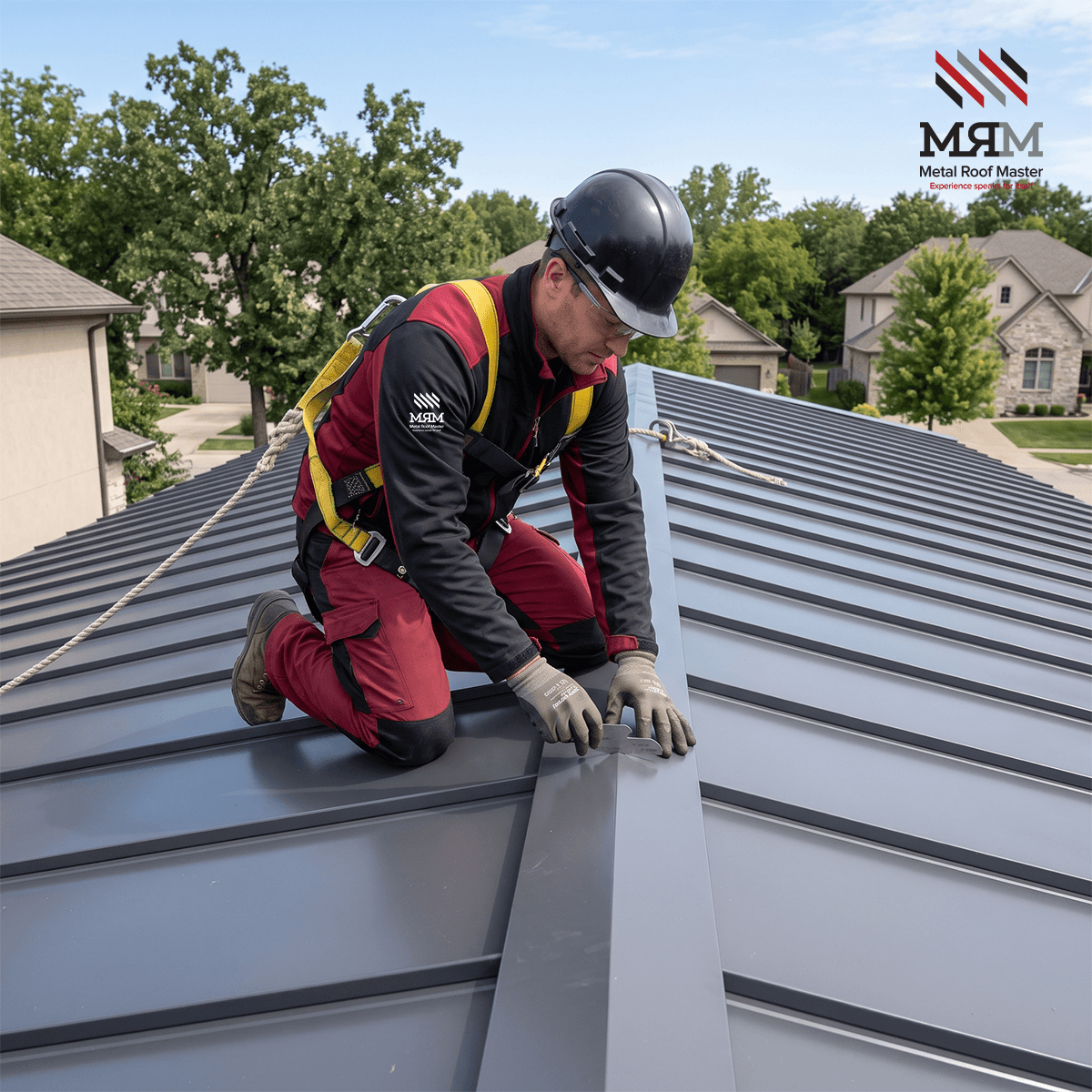
Standing seam roofs rarely fail on install day. A poorly executed standing seam installation typically looks fine when the crew packs up, then develops leaks, oil canning, or fastener problems months or years later, once seasonal temperature swings and storm cycles expose whatever wasn't done correctly. These five mistakes account for most of the callbacks and premature failures in the industry — recognizing them helps you evaluate a contractor's work before problems show up.
1. Restricting Thermal Movement
Standing seam panels are engineered to expand and contract with temperature changes, and the entire clip and seam system is designed around allowing that movement to happen freely. Pinning a panel in place — by face-fastening at the eave or through the ridge cap, or by misaligning fixed and floating clips — is one of the most common and consequential mistakes in the trade.
• Panels typically need a defined fixed point (usually at one end) and a free-sliding condition at the other, allowing the panel to grow and shrink without stress building up at the seams
• Face-fastening a panel at both the eave and ridge effectively pins it at both ends, leading to buckling, oil canning, and fastener tearout as the trapped panel has nowhere to go during thermal cycling
• On longer panel runs (often 25 feet or more, depending on manufacturer specifications and climate), two-piece expansion clips become necessary rather than simple fixed clips — using the wrong clip type for the panel length is a frequent source of this problem
2. Incorrect Clip Placement and Spacing
Even with the right clip type selected, installing clips in the wrong position or at incorrect spacing undermines the system's ability to manage thermal movement and wind load simultaneously.
• Every clip in a run generally needs to be installed in a consistent position relative to the panel's fixed or floating design — inconsistent placement causes the roofer to effectively guess how the panel will move, leading to binding at the seams
• Clip spacing that's too wide for the wind zone and panel gauge can leave a roof under-fastened relative to its actual wind-uplift requirement, even if the panel and coating themselves are correctly specified
• Binding caused by misplaced clips shows up as oil canning, seam distortion, and accelerated sealant deterioration at the seams — problems that often don't appear until after the first significant seasonal temperature swing
3. Substrate and Deck Issues
Metal panels reflect whatever is underneath them. A deck with dips, uneven areas, or inadequate support telegraphs directly through to the panel surface, creating oil canning and waviness that no amount of careful panel installation can fully correct.
• The roof deck should be flat, dry, and securely fastened before panel installation begins — installing over an uneven or compromised deck essentially guarantees a visibly imperfect finished surface
• Adequate backing support during installation matters as much as the deck condition itself, particularly at panel edges and seams where support is most critical
• This is one of the reasons a full tear-off to the deck, rather than installing over an existing roof, is generally recommended — it's the only way to properly assess and correct deck condition before the new panels go on
4. Inconsistent Panel Width and Layout
Standing seam performance depends on consistent panel width and alignment across the entire roof. Even small dimensional inconsistencies, if not caught early, compound across a long panel run into visible misalignment and problematic terminations at the ridge or hips.
• Panels can grow or shrink slightly in actual dimension during fabrication and installation, and waiting until the last panel goes on to verify overall alignment can create problems that are difficult to correct at that point
• Using layout planning (whether software-assisted or careful manual measurement) before starting installation helps ensure uniform panel spacing and clean terminations at hips, valleys, and ridges
• Inconsistent layout is often a visual problem rather than a performance one initially, but poor terminations at ridges and valleys can also create water-shedding weak points over time
5. Rushed or Incomplete Flashing and Sealant Details
Flashing transitions and sealant application at penetrations are exactly the kind of detail work that looks fine on install day but reveals problems only after the assembly is tested by real weather — and they're also the details most likely to get rushed on a tight schedule.
• Sealant application at seams, valleys, and penetrations needs to match the manufacturer's specified product and application method — an overlooked or improperly applied sealant joint is a common source of leaks that don't appear for months
• Flashing at transitions (roof-to-wall, valleys, penetrations like vents and skylights) needs individualized attention rather than a one-size-fits-all approach, since these are the highest-risk water-entry points on any roof
• Protective film left on panels too long is a smaller but real issue — it can become difficult to remove cleanly and create unnecessary cleanup, cosmetic, or adhesion issues if overlooked past the manufacturer's recommended removal window
What to Ask Before Hiring a Contractor
Since most of these mistakes aren't easily visible until months or years after installation, the more reliable safeguard is vetting your contractor's process before work begins rather than trying to inspect for these issues after the fact.
• Ask how they handle clip selection and placement for your specific panel length and expected temperature range, and whether they follow the manufacturer's installation manual specifically for fixed versus floating clip positions
• Ask about their deck inspection and preparation process before panel installation, since substrate issues are difficult to correct after panels are installed
• Request references or examples of standing seam projects they've completed, ideally ones installed at least a few years ago, since many of these mistakes only reveal themselves after seasonal cycling
Why These Mistakes Matter More on Standing Seam Than Other Systems
Standing seam isn't necessarily more difficult to install than other roofing systems, but it's considerably less forgiving of small errors. A slightly out-of-square panel, an overlooked sealant application, or the wrong trim detail on an asphalt shingle roof might not create a lasting problem — on standing seam, those same small missteps tend to surface later as leaks, oil canning, or callbacks, precisely because the system relies on precise, consistent execution across every seam and clip.
Warning Signs Worth Watching For
A few observable signs, whether during installation or in the months afterward, can indicate one of these mistakes may have occurred, even before a full leak develops.
• Visible waviness or oil canning appearing within the first year, especially if it seems to worsen with seasonal temperature changes rather than staying constant
• Loose panels, unusual noise, or visible movement at seams during windy conditions, which can indicate improper clip installation or spacing
• Rust or corrosion appearing at fastener points earlier than expected, which can point to incompatible fastener selection or damaged coating from installation
• Uneven panel alignment or inconsistent seam lines visible from the ground, suggesting layout or dimensional consistency issues during installation
Any of these signs are worth raising directly with your contractor promptly rather than waiting to see if they worsen — catching an installation issue early is generally far less costly than addressing a full leak or panel failure later.
Frequently Asked Questions
What causes oil canning on a standing seam roof?
Oil canning is typically caused by restricted thermal movement (panels pinned rather than free to expand and contract), an uneven substrate telegraphing through the panel, or inconsistent panel manufacturing — it's primarily a cosmetic issue rather than a structural failure.
Why do standing seam installation problems show up months after installation instead of immediately?
Most installation mistakes involve thermal movement management, which only becomes stressed after the roof experiences its first significant seasonal temperature swings — a roof can look correctly installed on day one and still develop leaks or oil canning once that cycling begins.
How do I know if my roofing contractor installed clips correctly?
This is difficult to verify visually after installation, which is why choosing a contractor with documented standing seam experience matters — ask specifically about their clip placement process and how they handle thermal movement on panel runs over 25 feet.
What should I do if I notice oil canning after my roof is installed?
Raise it with your contractor promptly. While oil canning itself doesn't affect structural performance, it can indicate an underlying issue (restricted thermal movement, substrate problems) worth investigating before it develops into something more serious.