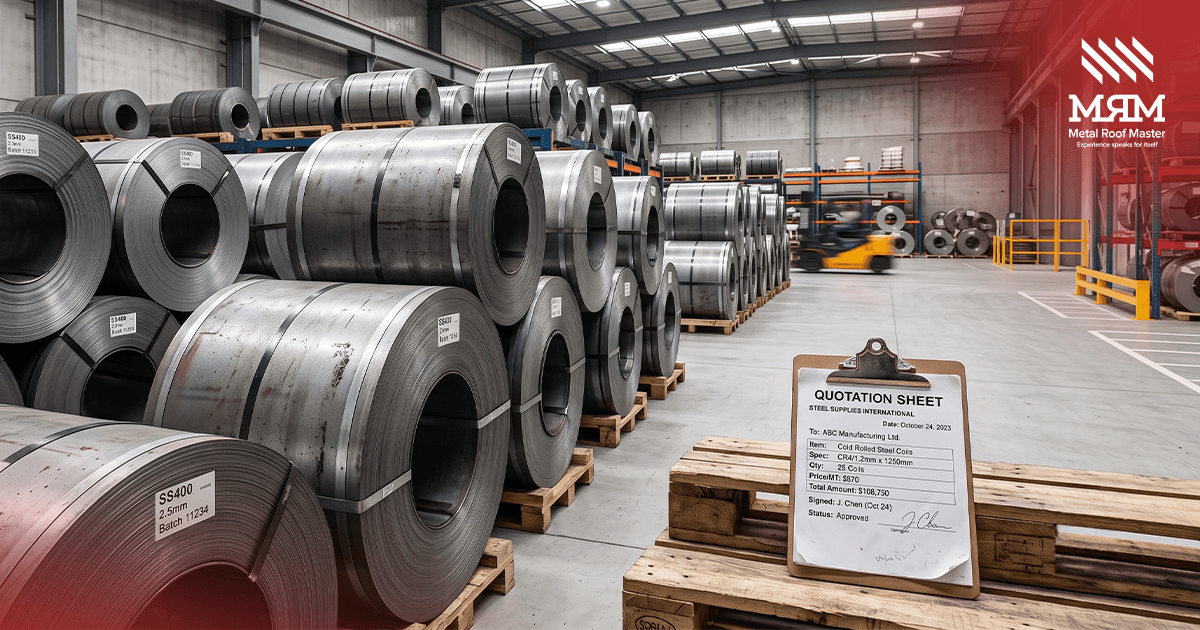
A roofing project's timeline depends on more than a contractor's schedule — it depends on whether the steel coil behind the panels actually shows up when planned. Buyers rarely see this part of the supply chain, but understanding how material actually gets sourced explains why some suppliers can hold a delivery date through a disruption that would stall a single-mill supplier entirely.
What "Single-Mill" Sourcing Actually Means
Many roofing material suppliers, whether they advertise it or not, source coil from one mill relationship or one country of origin by default.
● A single-mill arrangement can offer consistency and a straightforward paper trail, which works fine until that one mill faces a disruption
● Disruptions aren't rare or exotic: scheduled maintenance shutdowns, a trade remedy investigation affecting that specific origin, a shipping delay at one port, or a domestic price spike tied to one mill's production costs
● When the single mill is affected, the supplier's only options are to wait, absorb higher costs from a last-minute alternative, or pass a delay directly to the buyer's project timeline
What Multi-Mill Sourcing Changes
A multi-mill, asset-light sourcing model allocates purchasing across several partner mills and, often, several countries of origin rather than depending on one fixed source.
● If one mill relationship is disrupted, capacity can shift to another qualified mill without the project timeline depending on that single point of failure
● Sourcing decisions can be made based on current availability, current pricing, and current lead time rather than being locked into whichever single mill happens to be under contract
● This flexibility applies specifically to standards compliance too — capacity can be allocated toward a mill certified under the specific standard (ASTM, JIS, or EN) a given project actually requires
Why This Matters More in 2026 Than It Did a Decade Ago
Global steel sourcing has become more exposed to policy-driven disruption in recent years, which raises the practical stakes of a single-origin supply chain.
● Section 232 tariff modifications on steel and derivative products have been revised multiple times over the past year, changing effective landed costs by origin with each revision
● Anti-dumping and countervailing duty investigations targeting specific coated-steel exporting countries can add months of uncertainty and, eventually, new duty rates to material sourced from an affected origin
● A supplier locked into one origin has no flexibility to route around a newly announced duty or investigation; a multi-mill buyer can shift allocation while the situation develops
How This Shows Up in a Quote (and What to Ask About)
Multi-mill sourcing isn't usually visible on a price sheet, but its effects are — mainly in how a supplier responds when something goes wrong upstream.
● Ask a prospective supplier directly what happens to your lead time if their primary mill source faces a disruption — a vague answer is itself informative
● A supplier who can name backup mill relationships or alternate certified origins is describing real flexibility, not a marketing claim
● For time-sensitive projects — particularly pre-hurricane-season ordering — this question matters more than the headline price on a quote
The Trade-Off Worth Naming Honestly
Multi-mill sourcing isn't free of complexity, and it's fair for buyers to understand the trade-off rather than treat it as a strictly better option in every respect.
● Managing certification consistency across multiple mills (ensuring every batch, regardless of origin, meets the same ASTM specification) requires more active quality oversight than a single, long-standing mill relationship
● Documentation can be more complex when a project's material draws from more than one certified source over its duration, which is why clear mill test certificates matter more, not less, under this model
What This Means for Your Project Specifically
The practical takeaway for a homeowner or contractor evaluating quotes is less about the sourcing model itself and more about what it protects against.
● A multi-mill supply chain is primarily a hedge against delay, not a guarantee of the lowest price on any single day
● For projects with a firm deadline — insurance-driven replacement timelines, a hurricane-season target, a commercial project with a lease-up date — that delay protection can matter more than a marginal per-square difference in quoted price
Frequently Asked Questions
Does multi-mill sourcing mean lower-quality or inconsistent material?
No — properly managed multi-mill sourcing means every batch, regardless of which mill it came from, is still certified against the same required standard (ASTM A653, A792, A1046, etc.). The mill varies; the specification doesn't.
How would I know if my supplier only sources from one mill?
Ask directly. A supplier confident in their sourcing flexibility will typically describe it without hesitation; a supplier unfamiliar with the question may not have visibility into their own upstream supply chain.
Does this affect pricing, or only lead time?
Both, though the effect on lead time is usually more pronounced. Multi-mill sourcing can also provide pricing flexibility when one origin becomes temporarily more expensive due to tariffs or market conditions.
Is multi-mill sourcing only relevant for large commercial projects?
No — the same disruptions that delay a large commercial order also delay the coil behind a single residential re-roof. Project size affects order volume, not exposure to upstream disruption.